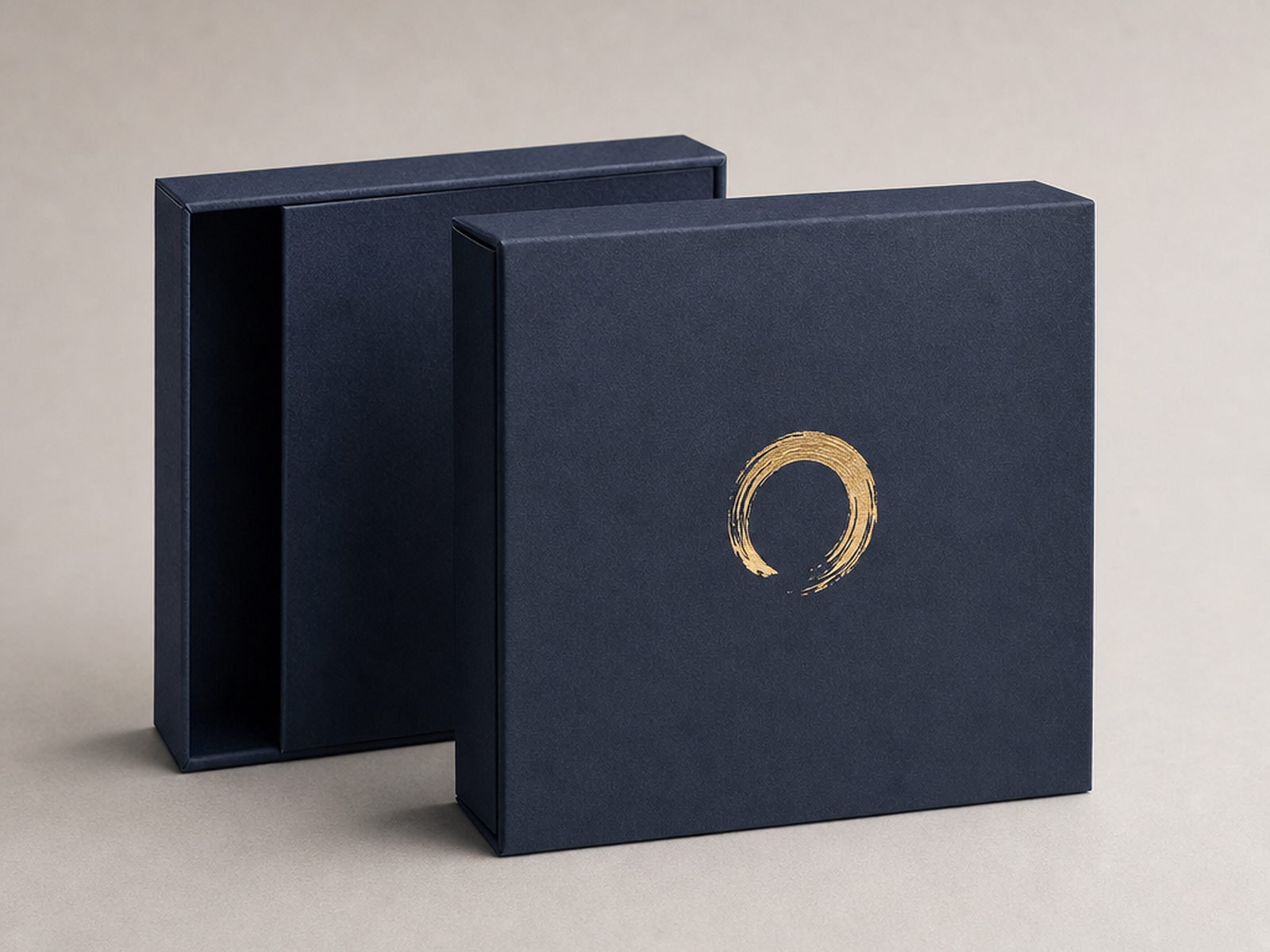
Custom Rigid Boxes: Set-Up Box Presentation Portfolio
A presentation portfolio of custom rigid boxes, breaking down greyboard thickness, wrap paper choices, and two-piece versus lid-and-base construction.
Custom rigid boxes are what buyers reach for when the packaging has to feel as considered as the product inside. Unlike a folding carton that ships flat and pops up, a rigid set-up box arrives pre-formed, solid, and weighty. This presentation portfolio breaks down the anatomy of the set-up box so you can see exactly what makes it feel premium and what that construction asks of a project.
Why Buyers Choose Custom Rigid Boxes
The decision to go rigid is almost always about perceived value. When a product sits at a premium price, or a moment needs to feel like an occasion — a flagship launch, a gift, a collector's edition — the packaging is expected to signal that before the lid ever lifts. A folding carton can look beautiful, but it cannot fake the heft and permanence of a wrapped chipboard box. That physical weight in the hand is the message, and it is the reason brands accept the higher cost and setup that rigid construction involves.
The Anatomy of a Set-Up Box
A rigid box is built around a chipboard core — greyboard, sometimes called greyboard rigid box stock — cut and formed into a permanent shape, then wrapped in a printed or specialty paper. There is no folding it flat; the structure is set, which is where the name comes from. That solidity is the entire appeal. The board carries the weight, the wrap carries the branding, and the two together create the substantial, doesn't-flex-in-your-hand quality that signals a heavyweight rigid box.
Greyboard Thickness
Thickness is the first lever. Heavier greyboard produces a more substantial, more protective box with crisper edges and a more luxurious hand-feel; lighter board trims cost and weight but gives up some of that presence. We recommend a caliper based on the product's weight, how protective the box needs to be, and the tactile impression the brand is chasing. There is a real trade-off between the premium feel of thicker board and the cost and shipping weight it adds, and we walk buyers through it honestly.
Wrap Paper Selection
The wrap is where the box speaks. Printed litho paper allows full-color graphics and PMS-matched brand color; specialty textured, uncoated, or colored stocks deliver a tactile, understated luxury without heavy printing. Finish choices layer on top: soft-touch lamination for a velvety hand, spot UV for contrast, foil stamping for metallic detail, and embossing or debossing for dimension you can feel. Each of these is an option matched to the brand and the budget, not a default.
Two-Piece vs Lid-and-Base Construction
Set-up boxes come in a few core constructions. A two-piece rigid box uses a separate lid that fits over a base — the classic shoulder-box or telescope style that delivers a satisfying, slow lift-off reveal. A lid-and-base with a partial-depth lid, magnetic-closure books, and drawer-style sliders are all variations we can build depending on the reveal you want. The construction shapes both the opening experience and the cost, so we match it to how the product should be presented and how the box will be used after opening.
Why Rigid Carries a 250-Unit Pilot Minimum
Rigid production is more hands-on than folding cartons — forming, wrapping, and assembling take more labor and setup — so rigid styles carry a 250-unit pilot minimum rather than the 100-unit pilot used for corrugated. That minimum reflects the setup involved in producing a genuinely heavyweight, wrapped box. It is still a sensible pilot for validating fit, finish, and the tactile weight buyers expect before committing to a larger run.
What to Send for a Rigid Box Quote
Send your product dimensions, the quantity you need (from a 250-unit pilot for rigid styles), your material and finish goals including any wrap or greyboard preferences, where the boxes ship, and your artwork status. If you have a target construction — two-piece, magnetic, or drawer — tell us, or describe the reveal and we will recommend one.
How We Manufacture Your Packaging
From initial concept to your doorstep, our streamlined manufacturing workflow guarantees precision at every stage:
Quote & Specs
Submit your dimensions, quantity, and design ideas. Receive a guaranteed wholesale quote within 1 business day.
Dieline & Proof
Our engineering team provides custom CAD dieline templates and interactive 3D digital artwork proofs.
Manufacturing
High-speed offset/digital printing, specialty foil/UV finishing, precision die-cutting, and automated folding.
Quality & Delivery
Rigorous ISO 9001 quality check, careful flat-pack bundling, and expedited insured delivery to your facility.
"The structural strength and color accuracy exceeded our expectations. Our product launch saw immediate retail pickup, and the unboxing feedback from customers has been phenomenal. GetPrintedBox delivered on time and within budget."
Frequently Asked Questions
Can this packaging design be customized for my exact product dimensions and branding?
Yes. Every project in our portfolio represents custom-manufactured packaging. Our structural dieline engineers create tailor-made CAD dielines based on your product’s exact dimensions, weight distribution, interior inserts, and branding specifications.
What is the minimum order quantity (MOQ) and production turnaround time?
Minimum order quantities start as low as 100 units for folding cartons and corrugated mailers, and 250 units for rigid setup luxury boxes. Standard manufacturing turnaround is 8 to 10 business days following artwork and dieline approval, with expedited rush production available upon request.
What printing methods and luxury finishing options are available?
We provide high-definition offset lithography, UV digital printing, and flexographic printing with up to 6 colors plus PMS Pantone color matching. Premium finish options include matte and gloss lamination, soft-touch velvet coating, spot UV, hot foil stamping (gold, silver, holographic), embossing, debossing, and custom die-cut windows.
Can we get a physical sample or 3D digital proof before full production?
Yes. Prior to bulk manufacturing, we provide an interactive 3D digital proof for your team to inspect alignment and colors. We also produce unprinted structural white samples or full digital pre-production prototypes for physical sign-off.
Are your packaging materials eco-friendly and sustainably sourced?
Yes. We utilize 100% recyclable, biodegradable, and FSC-certified paperboard, corrugated cardboard, and Kraft materials printed with non-toxic, eco-friendly soy-based inks.